AI agents thatask first.
Your agents stop for a human before the risky move, pick up where they left off after a crash, and record what every run cost.
The enforcement & evidence layer for durable AI.
Every model call is a durable step. On top of that, Duraton makes the things agents actually need in production - spend limits, human approval, and evaluation - primitives you declare, not infrastructure you assemble.
Durable model calls
A model call runs once. Its answer is saved the moment it lands, so a crash or a retry replays that answer instead of paying the model a second time. Wrap the call in ctx.step.ai and you are done.
const { output } = await ctx.step.ai.generate("classify", { model: "claude-opus-4-8", prompt: `Classify: ${subject}`, output: triageSchema,});
Enforcement, not glue code
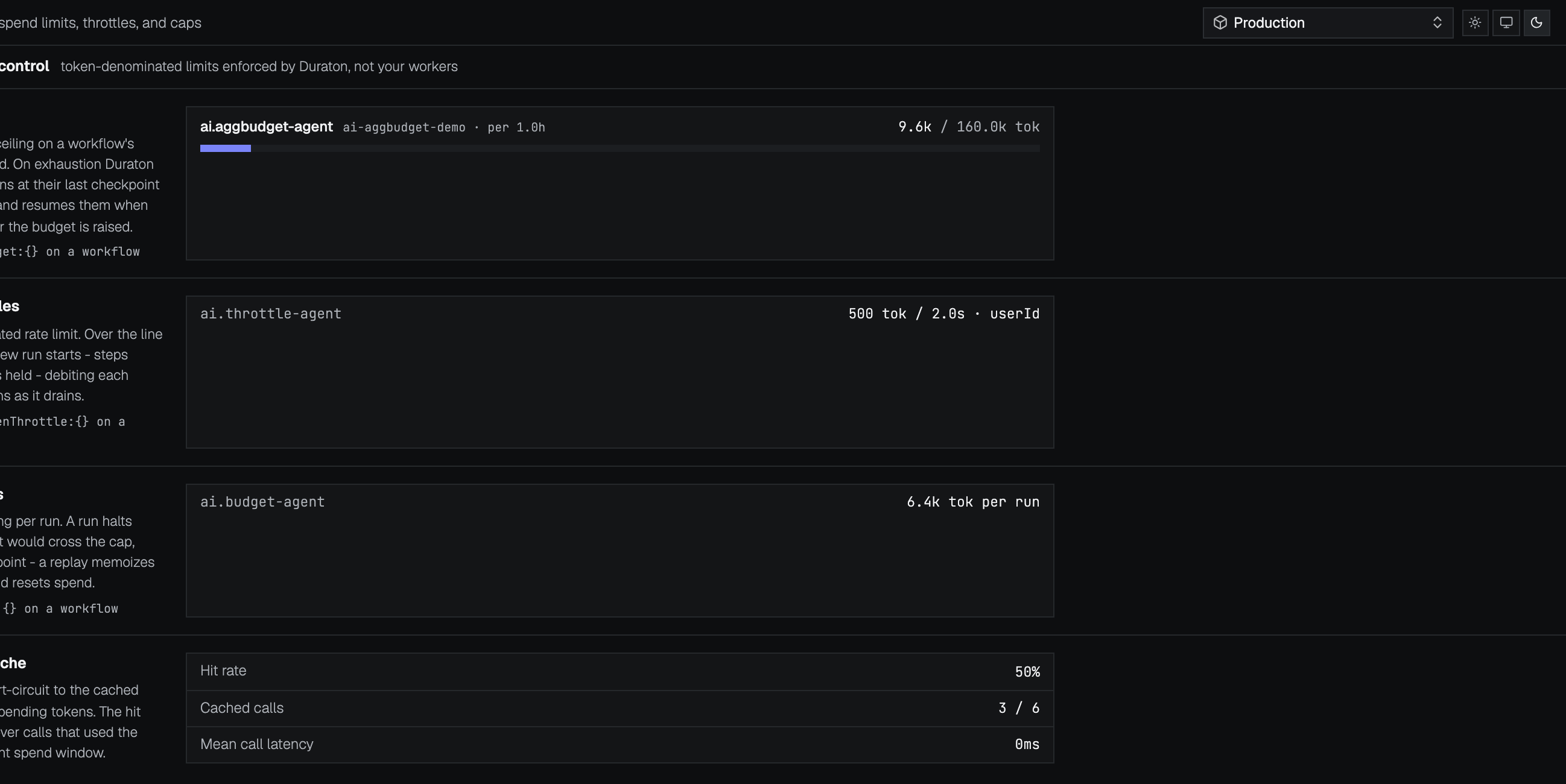
The run stops before it overspends, not after the bill arrives. A cap halts it just before the call that would cross the ceiling, and fails it there. A budget pauses over a rolling window and starts itself again. A throttle simply slows it down. All three are declared next to retry.
Agent loops
An agent that runs for hours survives a restart and picks up at its last finished turn, because every turn and every tool call is saved as its own step. A tool can be another workflow. That is ctx.step.ai.loop.
Resumable streaming
Show a model’s answer arriving word by word. Someone who opens the page late still sees it from the first word. The finished text is saved as the step’s result, so a replay never pays for the call again.
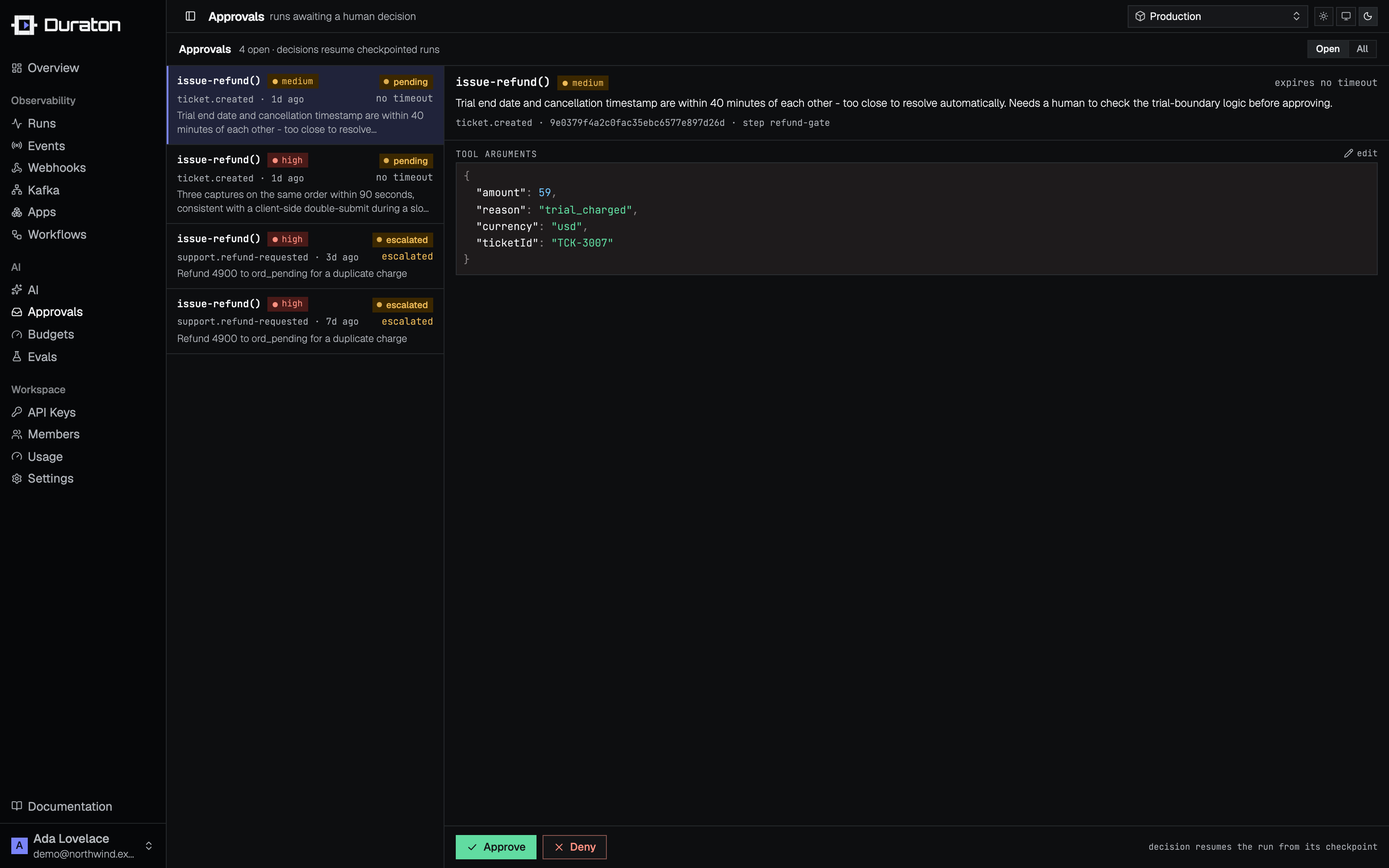
Human-in-the-loop
The run stops and waits for a person - for minutes or for days - without holding a worker while it waits. Approve it, deny it, or edit the arguments first; it carries on from exactly where it stopped. That is ctx.step.approval.
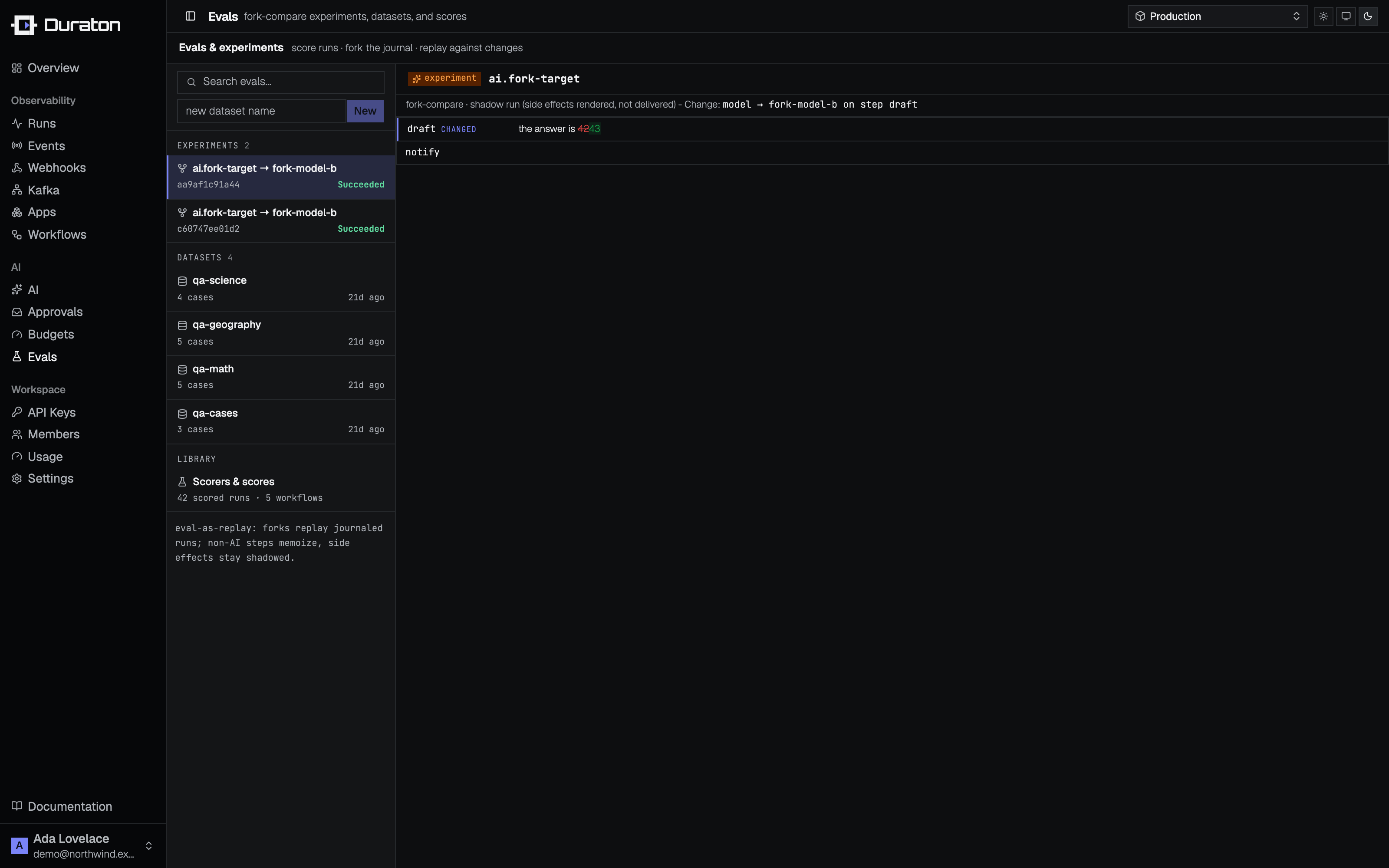
Evals as a primitive
Find out whether the new prompt is actually better. Score a run as it goes with ctx.score, grade it afterwards with an LLM judge, fork one real run with a single change and compare the two, or send a whole dataset through it. The evidence stays on the run.
Resilient by default
One provider having a bad afternoon does not take your feature down: a fallback chain moves past a rate-limited or unavailable model to the next one, across providers if it has to. And the exact same call, asked again, comes back from cache at no cost - deterministic calls only, since anything with a temperature is not one.
Your keys stay with you
The model call happens in your runner, with your provider SDK and your key. Duraton records metadata - model, tokens, latency, cost - and never sees your prompt, the response, or your key.
MCP-native
Agents are first-class operators: list and control runs, trigger events, score runs, and run fork-compares through the MCP server.
A durable runtime you can watch run.
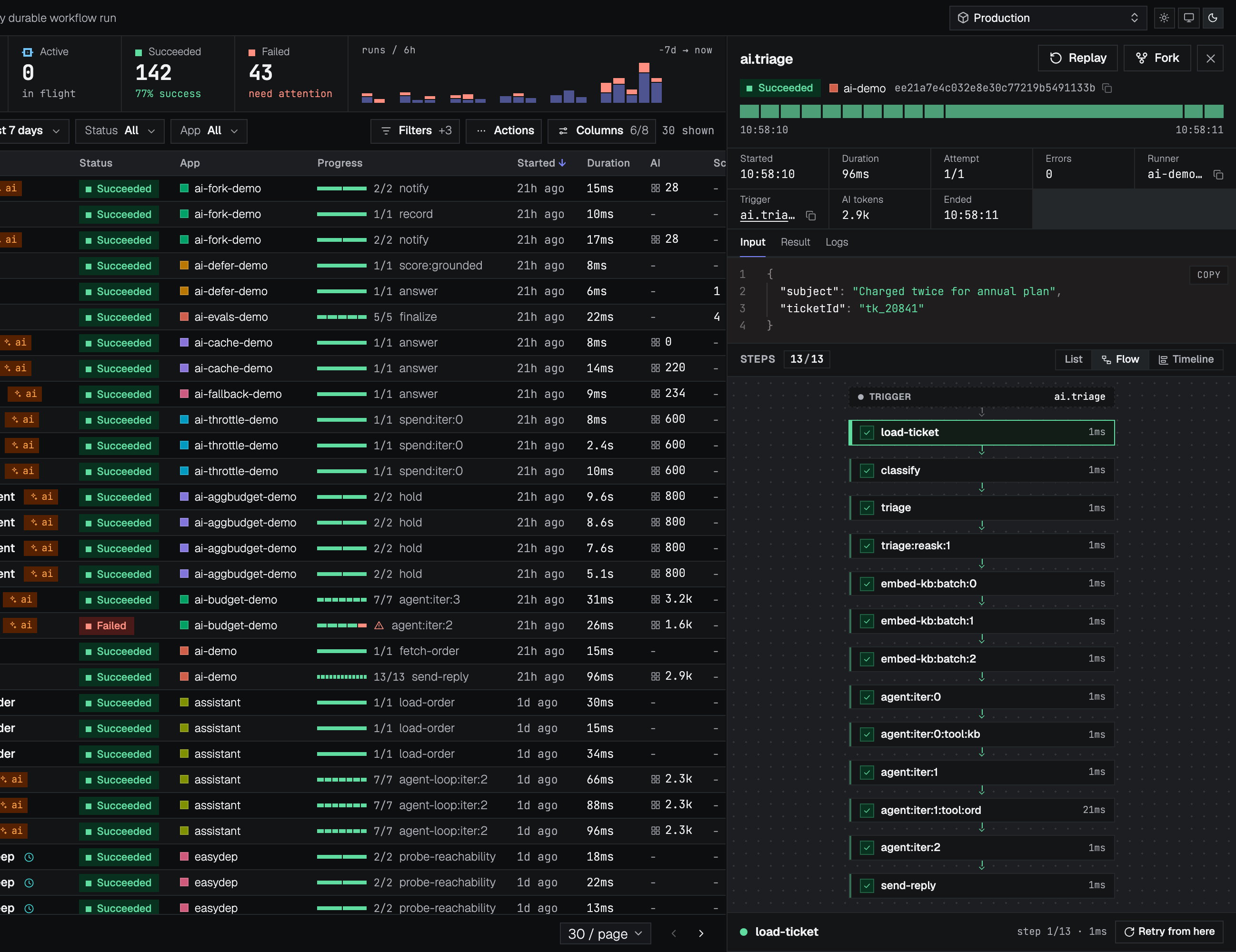
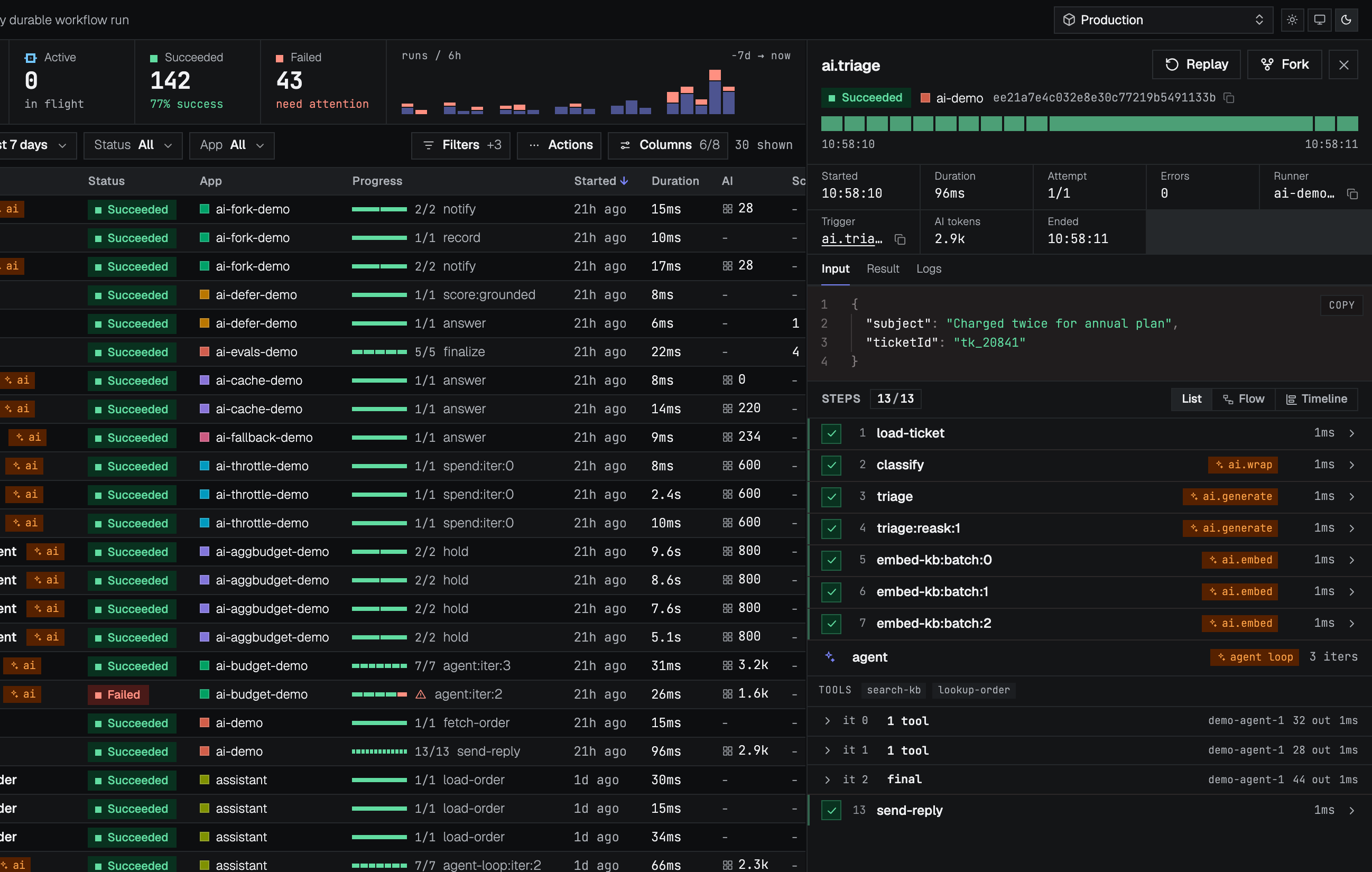
Each row pairs what you write with the live console view it produces.
Durable steps
Wrap each piece of work in a step. It runs once, its result is saved, and a crash picks the run back up at the next one - never re-running what already finished.
const triage = await ctx.step.ai.generate("triage", { model, prompt });await ctx.step.sleep("cool-off", "10s");return ctx.step.run("refund", () => issueRefund(ticket.id));
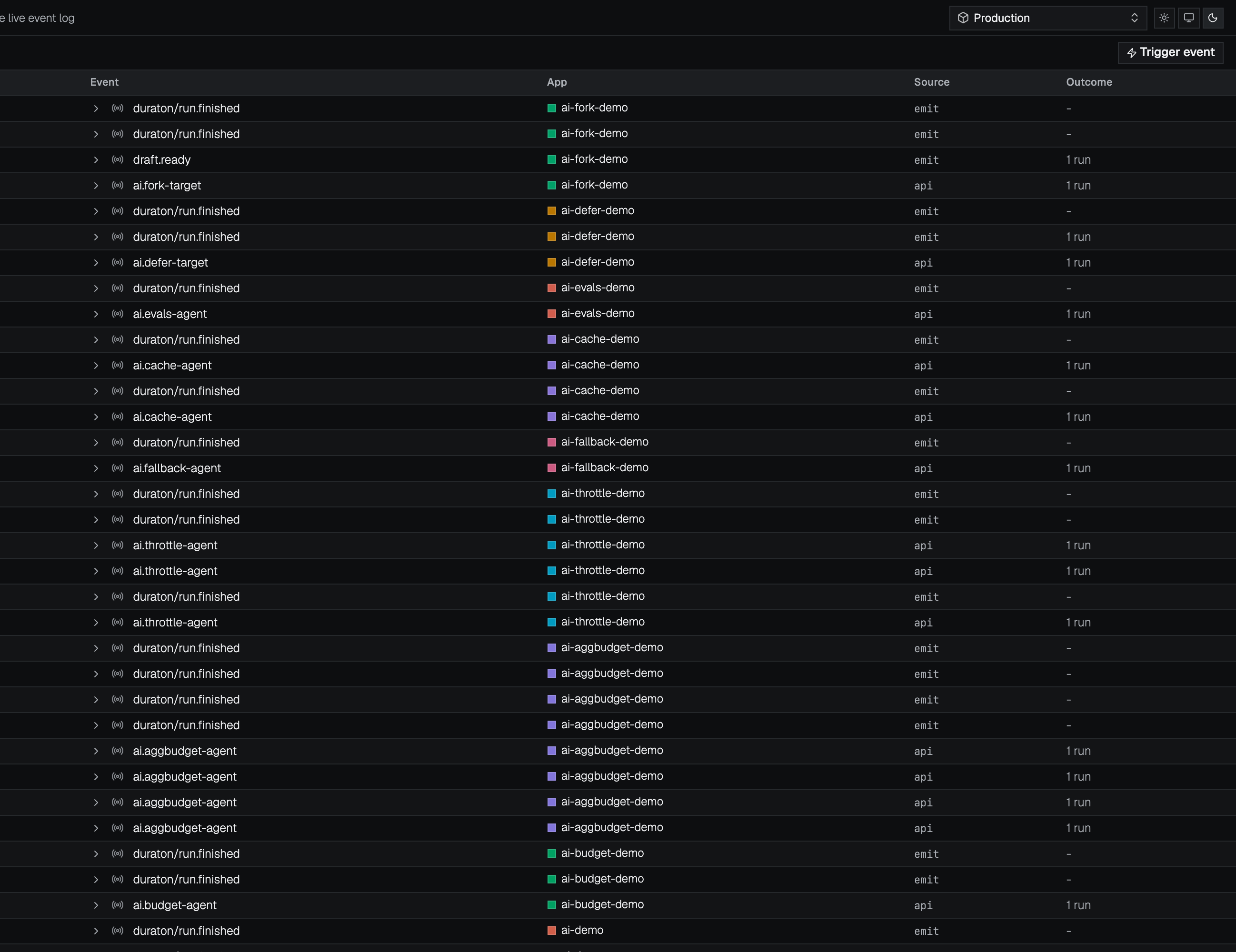
Events, filters & schedules
A run starts from whatever your business already emits: an event over REST, a webhook from a third party, a record on your own Kafka topics, or a schedule with no event at all. Fire only on the ones that matter by writing the condition inline. Every event is kept in a log you can replay.
defineWorkflow({ name: "welcome.pro", triggers: [{ event: "user.signup", if: 'event.data.plan == "pro"' }], handler,});
Flow control, declared
Eight controls live right next to retry on the workflow, enforced before a run starts. Pick one to see how it is declared.
Inspect, control, replay
Every run, step, input, output, token, and score is live in the console. Cancel, pause, resume, fork, or replay a finished run - and every webhook delivery, in and out, has its own attempt log you can redeliver or replay too.
import { createClient } from "@duraton/sdk/client"; const duraton = createClient({ engineUrl, apiKey });await duraton.runs.replay(runId); // also: cancel, pause, resume, fork
The same durable step, in your stack.
A single wire protocol drives every SDK. Author in TypeScript, Python, or Go; trigger and control from anything over REST. The step semantics are identical across all of them.
const triage = await ctx.step.ai.generate("classify", { model: "claude-opus-4-8", prompt: `Classify this ticket: ${subject}`, output: triageSchema,});
Managed, without handing over your secrets.
Keys never leave your runner
Model calls run on your side; Duraton stores only metadata.
Isolated per project
Runs, events, keys, and runners are scoped to a project boundary.
Signed invocations
Every runner call is signature-verified per key.
Durable audit log
Every control action is recorded with the actor behind it.
Ship agents that finish.
Durability isn't a library you write. Sign up, connect a runner, trigger a run - available today.